Visualisation feedback processes
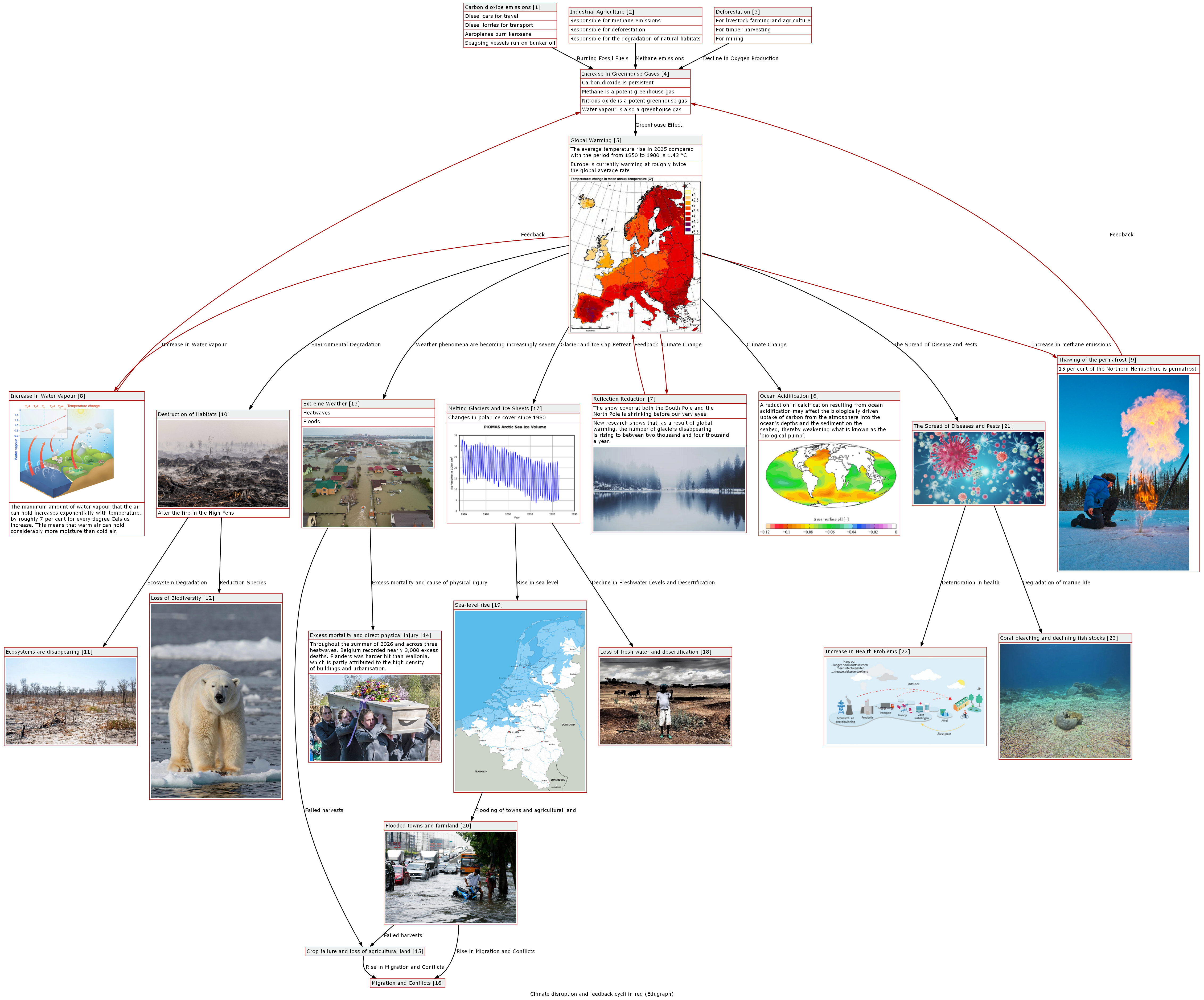
Proces notation climate_feedback
name:climate_feedback.Burning Fossil Fuels [1,4] = Carbon dioxide emissions [1] ► Increase in Greenhouse Gases [4];constraint:"true",
Methane emissions [2,4] = Industrial Agriculture [2] ► Increase in Greenhouse Gases [4];constraint:"true",
Decline in Oxygen Production [3,4] = Deforestation [3] ► Increase in Greenhouse Gases [4];constraint:"true",
Greenhouse Effect [4,5] = Increase in Greenhouse Gases [4] ► Global Warming [5];constraint:"true",
Climate Change [5,6] = Global Warming [5] ► Ocean Acidification [6],
Climate Change [5,7] = Global Warming [5] ► Reflection Reduction [7];color:"#a00000",
Increase in Water Vapour [5,8] = Global Warming [5] ► Increase in Water Vapour [8];color:"#a00000",
Increase in methane emissions [5,9] = Global Warming [5] ► Thawing of the permafrost [9];color:"#a00000",
Feedback [7,5] = Reflection Reduction [7] ► Global Warming [5];color:"#a00000",
Feedback [8,4] = Increase in Water Vapour [8] ► Increase in Greenhouse Gases [4];color:"#a00000",
Feedback [9,4] = Thawing of the permafrost [9] ► Increase in Greenhouse Gases [4];color:"#a00000",
Environmental Degradation [5,10] = Global Warming [5] ► Destruction of Habitats [10],
Ecosystem Degradation [10,11] = Destruction of Habitats [10] ► Ecosystems are disappearing [11],
Reduction Species [10,12] = Destruction of Habitats [10] ► Loss of Biodiversity [12],
Weather phenomena are becoming increasingly severe [5,13] = Global Warming [5] ► Extreme Weather [13],
Excess mortality and cause of physical injury [13,14] = Extreme Weather [13] ► Excess mortality and direct physical injury [14],
Failed harvests [13,15] = Extreme Weather [13] ► Crop failure and loss of agricultural land [15],
Rise in Migration and Conflicts [15,16] = Crop failure and loss of agricultural land [15] ► Migration and Conflicts [16],
Glacier and Ice Cap Retreat [5,17] = Global Warming [5] ► Melting Glaciers and Ice Sheets [17],
Decline in Freshwater Levels and Desertification [17,18] = Melting Glaciers and Ice Sheets [17] ► Loss of fresh water and desertification [18],
Rise in sea level [17,19] = Melting Glaciers and Ice Sheets [17] ► Sea-level rise [19],
Flooding of towns and agricultural land [19,20] = Sea-level rise [19] ► Flooded towns and farmland [20],
Rise in Migration and Conflicts [20,16] = Flooded towns and farmland [20] ► Migration and Conflicts [16],
Failed harvests [20,15] = Flooded towns and farmland [20] ► Crop failure and loss of agricultural land [15],
The Spread of Disease and Pests [5,21] = Global Warming [5] ► The Spread of Diseases and Pests [21],
Deterioration in health [21,22] = The Spread of Diseases and Pests [21] ► Increase in Health Problems [22],
Degradation of marine life [21,23] = The Spread of Diseases and Pests [21] ► Coral bleaching and declining fish stocks [23].
label:Climate disruption and feedback cycli in red (Edugraph).
Educative directed graph climate_feedback
Downloads
Dowload PNG (1937px op 1066 px)
Dowload TIF (CMYK voor print) (4531px op 3771px)
Dowload PDF (A2)
Feedback, Cybernetica and AI
Feedback is a concept from cybernetics. It was introduced and was the subject of heated debate during the Cybernetica conferences of the Macy Group between 1946 and 1953. These were some of the first structured studies into interdisciplinarity. They formulated new concepts in the fields of systems theory, cybernetics and what would later become known as cognitive science. It was a genuine paradigm shift. Everything became a system. One of the themes that came up at most conferences was reflexivity. Claude Shannon, one of the participants, had previously worked on information theory, which regarded information as a probabilistic element that reduced uncertainty in a series of choices.
All systems were lumped together. For both closed systems (mechanical, electrical) and open systems (sociological, biological, ecological, meteorological), reflexivity was defined as feedback. However, whilst mechanical and electrical systems can be perfectly controlled, this is not the case with sociological, biological, ecological, meteorological and climatic systems. And… that’s where it went wrong. And that misconception still plays an… important role today. The basis of social networks is ‘social… engineering’. With the scandal surrounding Cambridge Analytica it got completely out of hand. A second criticism of those views on feedback was subsequently put forward by the team at the ‘Biological Computer Lab’. They questioned the arbitrariness involved in defining systems and system boundaries. The latter is clearly illustrated in the following example. Disagreements over feedback had already arisen during Macy’s conferences as well. See, for example, the debate between Ashby and Bigelow on homeostasis (Müler, 2000).
If one reduces the feedback from global warming to the interaction between a reduction in albedo [7] and global warming [5], one overlooks the feedback arising from the interaction between an increase in water vapour [8] and the increase in greenhouse gases [4] on the one hand, and the interaction between the increase in methane emissions [9] and the increase in greenhouse gases [4] on the other. This also makes it clear that CO₂ storage, even if it could be implemented on a large scale – which is not yet the case – would have only a minimal effect. When considering open sociological, biological, ecological, meteorological and climatic systems, one must examine all influences as broadly as possible, both in terms of the system’s feedback mechanisms and the consequences of its uncontrollable dynamics.
Wiener is regarded as the founder of cybernetics. He is also seen as one of the first to have developed the theory that all intelligent behaviour was the result of feedback mechanisms that could potentially be simulated by machines (Wiener, 1848). This was seen as the crucial first step towards the development of modern artificial intelligence. Wiener’s work had a major influence on the computer pioneer John von Neumann. And even today, for Thielman, Musk, Zuckerberg and Altman, control remains the primary motivation for further developing AI. As far as climate disruption is concerned, however, they are faced with a colossal failure of cybernetic controllability. They would rather come up with doomsday scenarios than admit they were wrong. This, incidentally, is a fundamental tenet of all autocrats.
Naomi Klein and Astra Taylor argue that whilst these billionaires do predict the end of civilisation, they believe they can survive thanks to technology (Klein, Taylor, 2026). It is clear that this caste does not wish to relinquish the illusion of control. But the fundamental truth about the disruptive AI sector is that it requires an unprecedented amount of resources. The ‘computing power’ of high-end chips requires enormous quantities of data, which must be collected on a massive scale. In the process, copyright is disregarded, with thousands of books being used for scanning and then thrown away. Moreover, this data has to be cleaned up by low-paid staff spread across the Global South. A truly alarming rise in energy and water demand means that, as well as being environmentally polluting, this industry is also further disrupting the climate. But the resistance against these enormous datacenters is growing. We have entered a new, ominous era of imperial power, in which AI is racing ahead at breakneck speed without looking back, according to Karen Hao. (Hao, 2025).
And just how brilliant is this AI? It excels at creating computer programmes – closed systems, in other words. It can detect errors in these and thus hack into them online. It’s also good at coaxing users into becoming hooked on the internet. But apart from that, it simply produces cleverly disguised plagiarism. AI slop.
The irony is that, whilst developing “superintelligence”, they have now also lost control of it. At any rate, that is how they are portraying it. The aim of this propaganda stunt is, of course, to create fear and to humiliate 99 per cent of humanity. Whilst the EU is attempting to rein in AI, little good can be expected from the US government. It is absolutely determined to win the race against China. In robotics, they have already fallen behind.
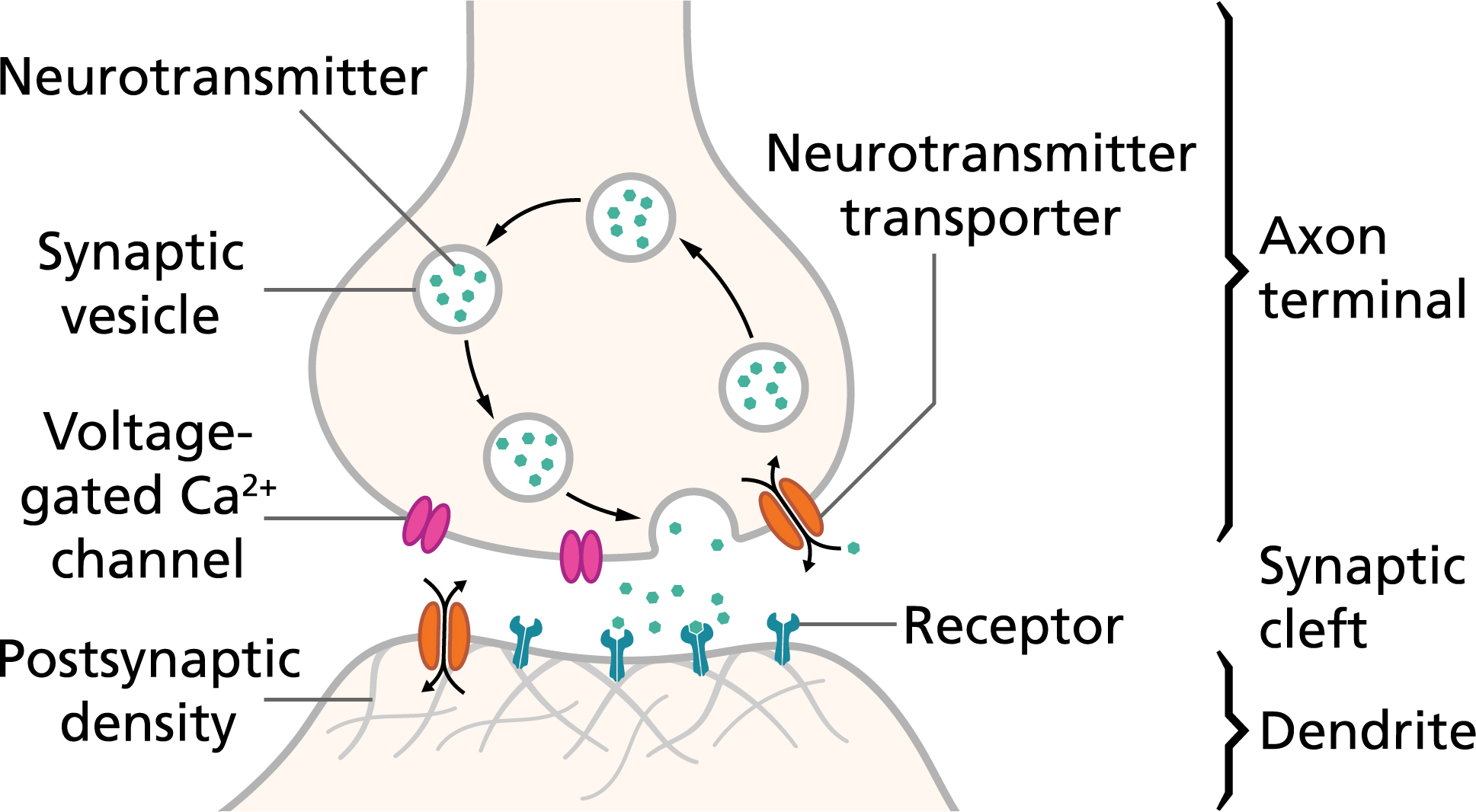
Just an anecdote: this isn’t the first time the US government has made a mistake regarding AI. Once computer production really took off in the 1960s, DARPA funded AI research by both the group led by Minsky, which based its model of human intelligence on the computer model, and the BCL, which drew on neurology. At the BCL, Rosenblatt, Edelman, Rumelhart and McClelland laid the foundations for the neural networks we know today. At the time, they called them ‘perceptrons’ rather than ‘neurons’, but the concept was the same as that of the neural networks modelled on the functioning of the neurons and synapses in our brain. It is, however, a very incomplete replica. In addition to electrical signals, neurotransmitters also play a central role. The neurotransmitter can either help (stimulate) or hinder (inhibit) a neuron in firing its own action potential, in accordance with the neurology course.
Following a decision by the US government, the BCL lost its funding – it was too progressive and did not stifle the students’ criticism of the Vietnam War – whilst Minsky’s research continued to be funded (Müler, 1985). But that investigation came to nothing. This is called the AI winter and it took twenty years.
Referenties
Müller, A. (2000). Eine kurze Geschichte des BCL: Heinz von Foerster und das Biological Computer Laboratory. Österreichische Zeitschrift für Geschichtswissenschaften, 11(1), 9–30. https://doi.org/10.25365/oezg-2000-11-1-2 <https://constructivist.info/radical/papers/mueller/mueller00-bcl.html>.
Klein, Naomi, & Astra Taylor, 2026, End Times Fascism and the Fight for the Living World, ISBN 10: 0374621381 ISBN 13: 9780374621384, Publisher: Farrar, Straus and Giroux, 2026
Hao. Karen, 2025, Empire of AI, Inside the reckless race for total domination, ISBN 978-0593657508, Penguin Press (U.S.).
Wiener, Norbert (1948). Cybernetics: Or control and communication in the animal and the machine. Cambridge, Massachusetts: MIT Press.